
Best Cloud Phone Systems in 2026: Our Top Picks for Every Business Size
If you have ever had a call drop mid-conversation with a client or struggled to connect your remote team through a clunky office phone system, you already know the problem. Traditional phone setups are expensive to maintain, difficult to scale, and simply not built for the way businesses operate today. That is where a cloud business phone system comes in.
In 2026, more businesses than ever are making the move to cloud-based communication. And it is not hard to see why. You get better call quality, flexible features, and the ability to manage everything from a single dashboard, whether your team is in one office or spread across five time zones.
This guide breaks down the best cloud phone systems available right now, what each one offers, and how to figure out which one actually fits your business.
What Is a Cloud Business Phone System?
A cloud business phone system routes calls over the internet instead of traditional copper phone lines. There is no physical hardware to install or maintain on your end. Everything lives on remote servers managed by your provider, and you access it through an app or browser.
This setup gives you serious flexibility. Employees can make and receive calls from their laptop, mobile phone, or a desk phone, all under the same business number. You can add or remove users in minutes, set up call routing rules, and get detailed analytics, all without calling an IT technician.
What to Look for in a Cloud Phone Service Provider?
With so many cloud phone service providers on the market, it can be overwhelming to compare them. Here are the key factors worth paying attention to:
- Call quality and uptime: Look for providers that offer at least 99.9% uptime and HD voice quality.
- Scalability: Can you easily add users as your team grows?
- Integration options: Does it connect with your CRM, helpdesk, or productivity tools?
- Mobile and desktop apps: Your team should be able to use it from anywhere.
- Pricing transparency: No hidden fees, clear per-user pricing.
- Customer support: Responsive support matters, especially during setup.
Best Cloud Phone Systems in 2026
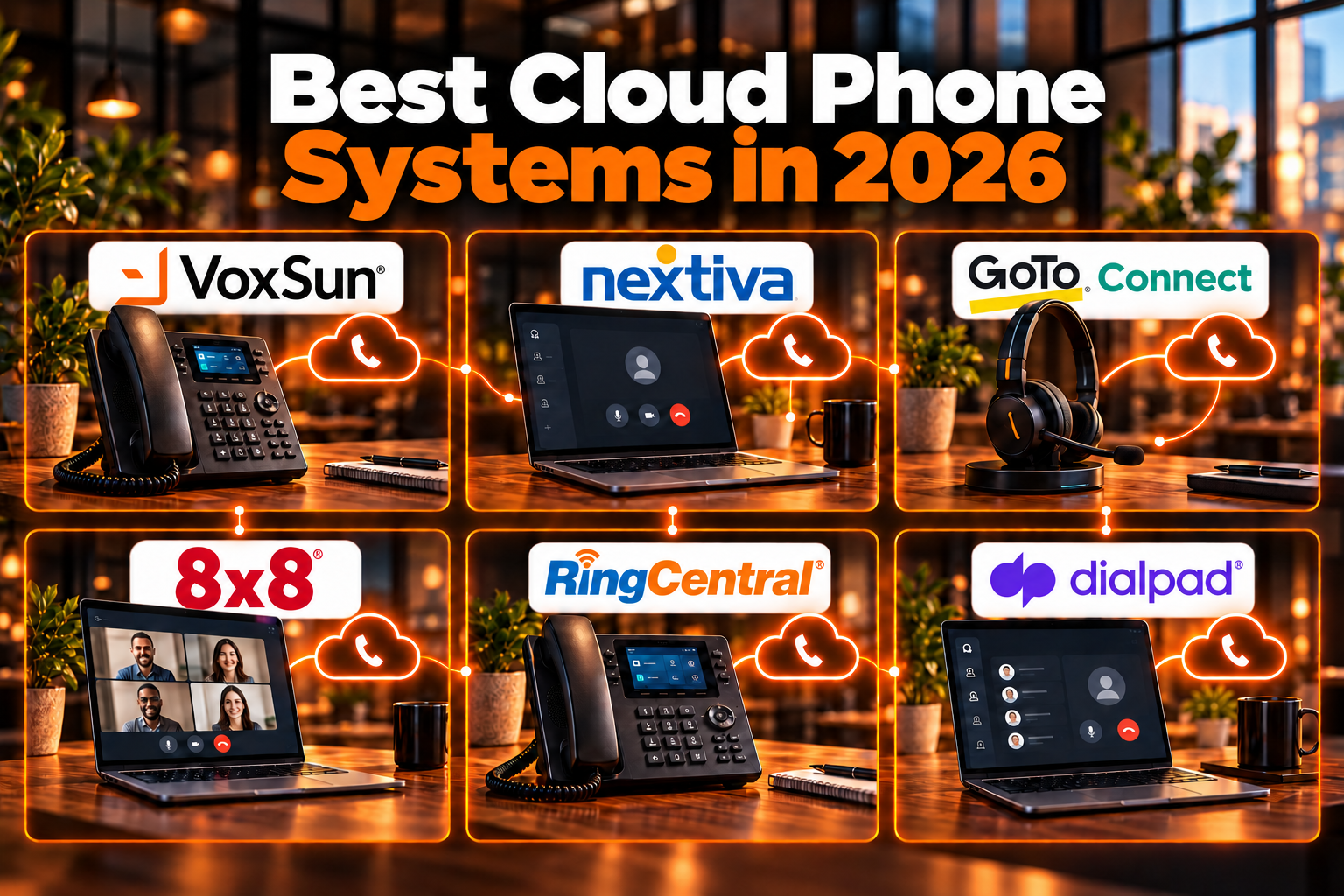
1. Voxsun
Voxsun is a strong contender for businesses that want an all-in-one cloud business phone system without the complexity of enterprise software. It is built for clarity, with clean call management features and a setup process that does not require a technical background.
What stands out is its flexibility across business sizes. A solo consultant can get started quickly, and a growing team of 50 can scale without switching platforms. The interface is clean, call routing is straightforward, and support is responsive.
2. RingCentral
RingCentral has been in the cloud communications space for years and is a reliable option for mid-sized to larger organizations. It covers voice, video, messaging, and fax under one roof. The feature set is deep, though that also means there is a learning curve for new users.
3. Nextiva
Nextiva is popular with customer-facing teams. It blends phone calling with live chat and CRM-like features, making it useful for support and sales teams. The setup is beginner-friendly and pricing is competitive at the entry level.
4. Dialpad
Dialpad leans heavily into AI. It offers real-time call transcription, sentiment analysis, and coaching prompts during live calls. If your team does a lot of outbound calling or sales work, these AI features can genuinely improve performance.
5. GoTo Connect
GoTo Connect works well for companies that already use other GoTo products. It is a solid all-rounder with strong video meeting capabilities built in. Pricing is straightforward and setup does not require much technical knowledge.
6. 8x8
8x8 is a good fit for businesses with international calling needs. It supports a wide range of countries with competitive rates and has strong compliance features, making it popular in regulated industries like finance and healthcare.
Best Cloud Phone System for Small Business
Small teams have different needs. You do not want to pay for 50 features when you only use five. Here is what to prioritize when choosing a cloud phone system for small business use:
- Simple setup with minimal technical knowledge required
- Affordable per-user pricing, ideally month-to-month
- Mobile app so your team can work from anywhere
- Basic call routing and auto-attendant features
- Reliable customer support when something goes wrong
Voxsun fits this profile well. It does not overwhelm small teams with features they will never use, and you can get up and running quickly. For teams just getting started, it is worth exploring what a purpose-built cloud business phone system can do before committing to a larger enterprise platform.
The Rise of AI Business Phone Systems
AI is no longer just a marketing term in the phone system space. An AI business phone system can now handle tasks that used to require a full-time receptionist or a dedicated support agent.
Modern AI features include:
- Automatic call summaries: No more manual note-taking after every call.
- Smart call routing: AI learns which team member is best suited for which type of inquiry.
- Voicemail transcription: Get voicemails converted to text and delivered to your inbox.
- Sentiment analysis: Know how a customer is feeling before you respond.
- Virtual receptionist: Handle after-hours calls and basic queries automatically.
For businesses that receive a high volume of calls, these AI tools can dramatically reduce response times and free up your team for more complex tasks. Even small businesses benefit from even the basics, like automatic transcription and smart voicemail.
How to Choose the Right Cloud Phone System for Your Business
There is no universal answer here. The right system depends on your team size, how your business communicates, your budget, and what tools you already use. Here are a few practical steps:
- List your must-haves: Do you need video calling? CRM integration? International numbers?
- Set a budget: Know what you can spend per user per month before you start comparing.
- Try before you buy: Most providers offer a free trial. Use it with your real workflow, not a test scenario.
- Check reviews from similar businesses: A hotel and a law firm have very different needs.
- Think about growth: Choose a system that can grow with you without forcing a platform change in two years.
Frequently Asked Questions
What is a cloud phone system?
A cloud phone system routes calls over the internet rather than through traditional phone lines. It is hosted by a third-party provider and accessed through an app or browser, with no on-site hardware required.
Are cloud phone systems reliable?
Yes, most reputable providers offer 99.9% uptime or higher. Call quality depends on your internet connection, but with a stable broadband connection, cloud systems typically deliver excellent voice quality.
How much does a cloud business phone system cost?
Pricing varies by provider and plan. Most charge on a per-user, per-month basis. Entry-level plans typically start between $15 and $30 per user per month, with more advanced plans ranging higher.
Can I keep my existing business number?
Yes. Most cloud phone service providers support number porting, which means you can transfer your current business number to the new system without any disruption to incoming calls.
What is an AI business phone system?
An AI business phone system uses artificial intelligence to enhance call management. This can include features like automatic transcription, smart routing, voicemail-to-text, and real-time call coaching.
Is a cloud phone system good for remote teams?
Absolutely. Cloud systems are built for flexibility. Team members can make and receive calls from any device with an internet connection, making them ideal for hybrid and remote work setups.