
VoIP vs Landline for UK Small Businesses: Which Is Better in 2026?
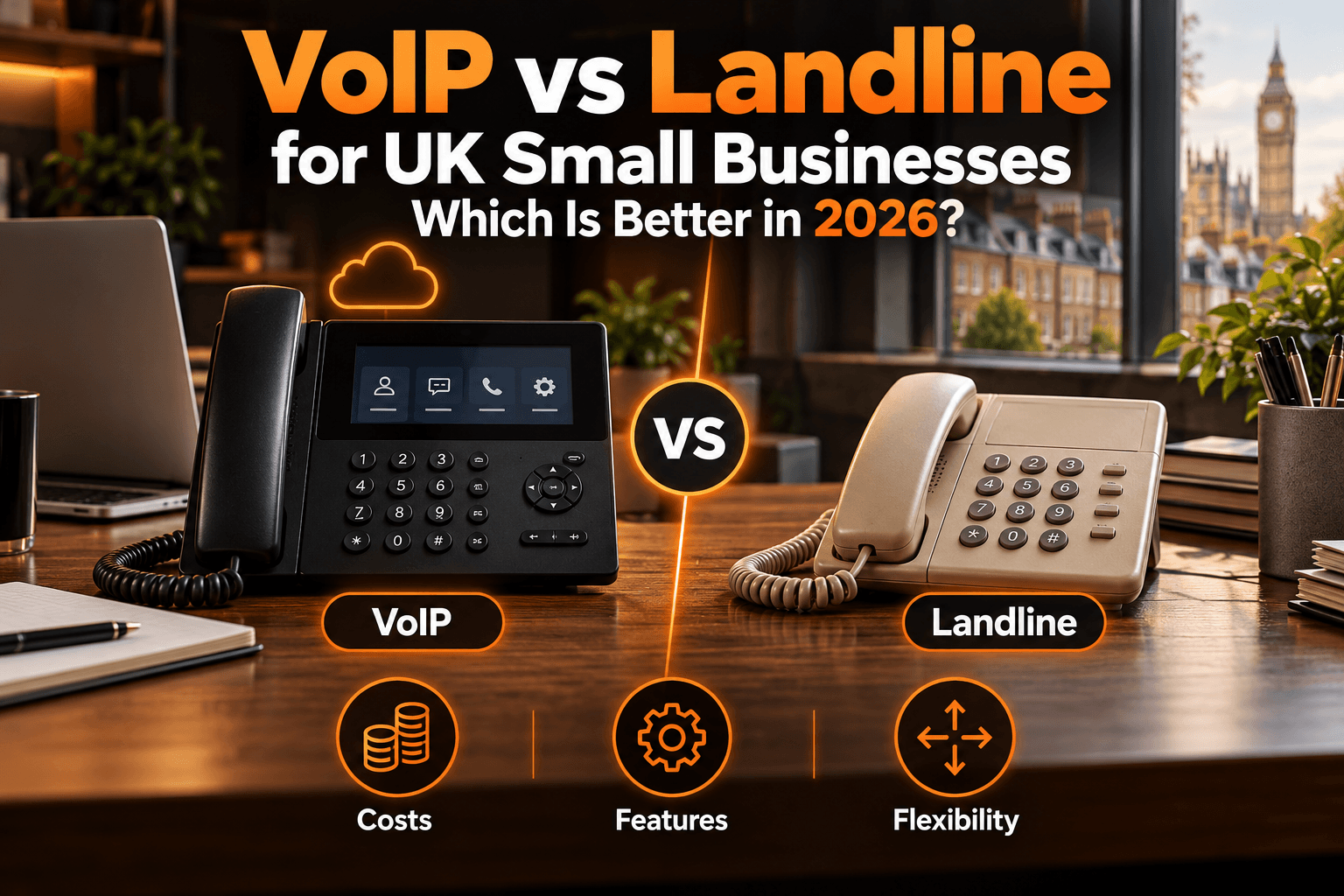
Choosing between VoIP and a traditional landline is becoming more important for UK small businesses as the country's telephone network moves towards fully digital services.
Traditional landlines have provided reliable business calling for decades, but modern companies increasingly need flexible phone systems that work across offices, mobiles, computers and remote locations. At the same time, businesses still using legacy PSTN services need to prepare for the UK's ongoing digital transition.
Openreach states that traditional PSTN phone lines are scheduled to move to digital services by 31 January 2027. Businesses relying on older telephone infrastructure should therefore review their phone systems and any connected equipment before the deadline.
This guide compares VoIP vs landline for small business use, including cost, reliability, call quality, features, scalability and what the PSTN switch-off means for UK businesses.
Key Takeaways
- VoIP uses an internet/IP connection, while traditional landlines rely on fixed legacy phone infrastructure.
- VoIP works across desk phones, mobiles and computers, making it better suited to remote, hybrid and multi-location teams.
- Traditional landlines offer simpler basic calling, while VoIP adds features such as call routing, extensions, call recording, analytics and CRM integration.
- VoIP is easier to scale, as users, numbers and extensions can usually be added without major physical infrastructure changes.
- VoIP depends on reliable internet and power, so UK businesses should plan for backup connectivity and business continuity.
VoIP vs Landline Business UK: The Short Answer
For most modern UK small businesses, VoIP offers more flexibility than a traditional landline because employees can make and receive business calls across desk phones, computers and mobile devices.
VoIP also makes it easier to add users, create extensions, change call-routing rules and support remote or hybrid teams.
Traditional landlines may still feel familiar for businesses with very basic calling requirements. However, companies that still depend on legacy PSTN infrastructure also need to consider the UK's move towards digital telephone services.
The best choice should therefore be based on how your business actually communicates, not simply which technology feels more familiar.
What Is a Traditional Business Landline?
A traditional business landline uses fixed telephone infrastructure to connect calls. In the UK, legacy telephone services have historically relied on the Public Switched Telephone Network, commonly known as the PSTN.
These systems were designed around fixed locations and physical telephone lines. A company might have one or more business numbers connected to desk phones within its office.
For many years, this offered a simple and dependable way to make business calls. However, fixed-line systems can become less practical when companies need employees to work from home, use multiple offices or manage calls across different devices.
What Is VoIP and How Does It Work?
VoIP stands for Voice over Internet Protocol. Instead of carrying calls through a traditional analogue telephone line, VoIP converts voice into digital data and sends it through an IP network.
Employees can typically make and receive calls through:
- IP desk phones
- Laptops and desktop computers
- Softphone applications
- smartphones
- Headsets
A modern VoIP phone system can also provide features that go beyond basic calling, including call routing, extensions, voicemail to email, automated receptionists, call records and CRM integration.
VoxSun's UK business phone system, for example, supports physical and virtual phones, existing number retention, CRM integration, automated reception and web-based system management.
VoIP vs Landline: Quick Comparison
| Feature | VoIP | Traditional Landline |
| Call delivery | Internet/IP network | Legacy fixed-line infrastructure |
| Location | Flexible | Usually tied to a location |
| Devices | Desk phone, mobile, computer | Mainly fixed handsets |
| Setup | Mostly software and service based | May require physical lines and hardware |
| Call routing | Advanced | More limited |
| Remote working | Well suited | Limited |
| Scalability | Easier to expand | More infrastructure dependent |
| Internet dependency | Yes | Traditional analogue lines less dependent |
| Integrations | CRM, analytics and software | Generally limited |
| Future UK fit | Designed for digital networks | Legacy PSTN infrastructure being retired |
These structural differences are what make the VoIP and landline decision important for small businesses rather than simply a comparison between two types of telephone handset.
7 Key Differences Between VoIP and Landlines
1. Cost and Pricing Structure
When comparing VoIP and landline for small business use, cost should be considered across the complete system rather than only the advertised monthly price.
VoIP costs may include subscriptions, users, phone numbers, devices, premium features and any network improvements required to support calling.
Traditional systems may involve line charges, hardware, maintenance, call charges and costs associated with making physical changes.
The important metric is therefore total cost of ownership and whether the system can grow without expensive infrastructure changes.
2. Setup and Maintenance
VoIP systems are generally more software-driven. Administrators can often add users, adjust extensions or update routing rules through an online portal.
Traditional systems are more closely linked to physical telephone infrastructure and may require more manual changes when a business expands or reorganises.
For a small company without a large IT team, ease of administration can be just as important as the initial installation cost.
3. Call Quality and Reliability
Traditional landlines developed a strong reputation for consistent calling because they were not dependent on a company's broadband connection.
VoIP works differently. Voice quality depends partly on the quality of the network carrying the calls. With a stable business internet connection and properly configured network, modern VoIP can provide high-quality voice calling. Businesses should therefore assess both the VoIP provider and their internet environment when comparing reliability.
4. Features and Call Management
One of the biggest differences in the VoIP vs landline comparison is functionality.
A modern VoIP system may support:
- Call forwarding
- Extensions
- Automated attendants
- Ring groups
- Voicemail to email
- Call queues
- Call recording
- Analytics
- CRM integration
- Video conferencing
Traditional landlines are primarily designed around calling and generally offer fewer software-based communication tools.
For companies managing customer enquiries or several departments, advanced call routing alone can significantly improve how incoming calls are handled.
5. Remote and Hybrid Working
VoIP is particularly useful for businesses whose employees are not always in the same office.
A team member can potentially use the same business phone system from home, another branch or while travelling, depending on the provider and configuration.
The business number remains connected to the organisation rather than one physical desk. This flexibility makes VoIP particularly relevant for hybrid working, distributed teams and mobile professionals.
6. Scalability
Adding employees to a traditional phone environment may require additional lines, handsets or infrastructure.
Cloud-based VoIP is usually easier to adjust because users, extensions, numbers and routing rules are managed through software. For a growing small business, this means the phone system can change alongside the organisation instead of requiring a major redesign every time the team expands.
7. Security and Business Continuity
Both technologies have reliability considerations.
Because VoIP is internet based, businesses should consider:
- Secure passwords
- Network security
- Encryption
- Provider security practices
- Backup internet connections
- Power resilience
Internet or power outages can affect IP-based calling if no backup arrangements exist.
A business continuity plan might therefore include mobile connectivity, call forwarding or another failover option so important calls are still handled if the main office connection becomes unavailable.
Which Is Better for Your Small Business?
There is no single answer that fits every organisation, but the following situations provide a useful starting point.
VoIP may be the better fit if you:
- Have remote or hybrid employees
- Need multiple users or extensions
- Operate across several locations
- Need advanced call routing
- Use a CRM or other business software
- Expect the company to grow
- Want calling across computers and mobiles
- Need detailed call management and analytics
A simpler phone setup may be enough if you:
- Have only a few users
- Work entirely from one location
- Need basic calling rather than advanced features
- Have unreliable broadband connectivity
- Do not require integrations or complex routing
However, a simple requirement does not necessarily mean a business should stay on legacy PSTN infrastructure. Companies using traditional lines still need to understand how their services will transition to digital technology before the 2027 deadline.
Final Thoughts
When comparing VoIP vs landline for small business, the decision should be based on connectivity, team size, mobility, call-management requirements, scalability and any existing equipment that still relies on traditional phone lines.
VoIP is particularly suited to businesses that want flexible calling across locations and devices, along with modern features such as routing, CRM integration and centralised management.
With the UK continuing its transition away from legacy PSTN infrastructure, now is also the right time for small businesses to review whether their current phone setup is ready for a fully digital future.
VoxSun provides cloud-based business phone systems designed to support modern teams across physical phones, computers and mobile devices.
Frequently Asked Questions
Is VoIP better than a landline for a small business?
VoIP is often better suited to small businesses that need flexibility, remote access, easier scalability and advanced phone-system features. Businesses with very basic requirements should still compare connectivity, reliability and total cost before choosing.
Is VoIP cheaper than a business landline?
It can be, particularly when a business needs several users, locations or advanced features. However, actual costs depend on subscriptions, hardware, call volume, internet requirements and the provider's pricing model.
Can I keep my existing business number when switching to VoIP?
Usually, existing business numbers can be transferred through number porting, although availability and migration requirements should be confirmed with the new provider before cancelling the existing service.